



 Across Australia, many people are adjusting to life with permanent changes in their vision.
These changes alter the texture of their days in ways that are often subtle but significant – a phone screen that’s harder to read, a bus number that takes longer to recognise, a familiar face that softens at a distance.
These shifts rarely happen all at once, and they don’t always fit neatly into the clinical conversation with your eyecare professional, yet they can significantly shape how people move through the world.
More than 280,000 Australians live with permanent low vision, and many do not qualify for funded support.
Their vision changes may not meet the threshold for legal blindness, but can still influence feelings around confidence, routine and independence in meaningful ways.
The lived experiences people share often speak to this subtle accumulation.
One SeeWay client, Suzi, described how she used to stop every bus on her route just to ask, ‘Are you the 413?’ Each time the answer was no, her confidence slipped a little more. It wasn’t about losing capability – it was the effort required to stay oriented in situations that once felt automatic.
For others, the impact shows up in their working life.
Patricia, a nurse, has spoken about wondering how long she can continue in her profession and what conversations she might eventually need to have with her employer. Her concerns centre around uncertainty – what practical adjustments are possible, what information she should share, and how to plan for the future in a way that feels grounded and realistic.
Research shows that early, practical support can make this adjustment period smoother.
When people begin exploring tools and strategies early on, the brain adapts more readily. The mental load is reduced with fewer moments of uncertainty and a stronger sense of control and confidence in navigating daily life.
Support doesn’t need to be intensive – it can be about having information that’s easy to understand, reassurance that the experience is valid, and simple tools to make familiar tasks continue to feel manageable, or achievable.
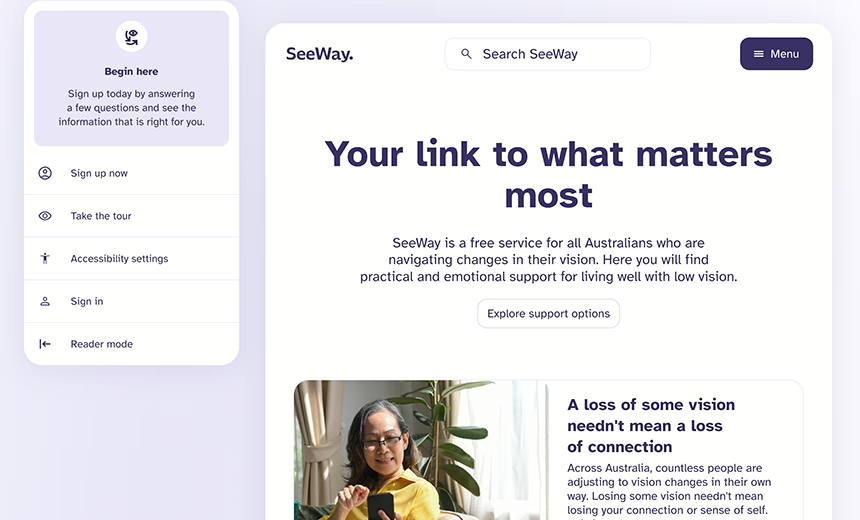
This is why SeeWay exists. It was created to help Australians who are living with permanent vision changes, but who may not qualify for traditional supports.
SeeWay looks at the everyday realities of some vision loss – how to stay connected, how to use technology comfortably, how to manage unfamiliar situations and how to navigate the emotional shifts that may arise.
Digital skills are a particularly important aspect for many people adjusting to some vision loss.
When technology becomes easier to use, through contrast settings, text-size adjustments, voice control or intuitive shortcuts, it can transform how people communicate, organise their routines and manage daily tasks.
For Suzi, these skills made a direct impact. Once she felt more comfortable using her phone, she was able to reconnect with her family on FaceTime – something she had quietly stepped back from when screens became more difficult.
Emotional support is another part of the adjustment journey that people frequently access later than they would have liked, often after managing alone for longer than was necessary.
Vision changes can affect not only practical independence but also identity, confidence and social connection. Having a place to talk openly about these experiences can help people feel steadier as they work out what’s going to be most helpful day to day.
Across the stories people share, a pattern emerges: when support is accessed early – whether emotional, practical or digital – adaptation often feels more manageable.
People regain confidence sooner, the brain adjusts more easily, and day-to-day life begins to feel more familiar again. SeeWay client Ben says, ‘It’s about taking control of the things you can have control over.’
For those wanting to explore guidance at their own pace, SeeWay offers free information, digital skills training and access to professional counselling, alongside links to reputable organisations across the low vision community.
All Australians with some vision loss, and their loved ones or carers, should know there is no threshold for seeking support. Permanent changes to vision don’t need to reach a certain stage or severity before support becomes worthwhile.
If vision changes are affecting daily life in any way – even in small, gradual or inconsistent moments – support is valid, appropriate and deserved.
Because a loss of some vision needn’t ever mean a loss of connection or sense of self.
More information is available at seeway.com.au
Phone: 02 8350 1400
Email: [email protected]
About the author: Holly Kelly is a communications specialist and qualified optical dispenser whose career across media and eye health has centred on creating clear and compassionate resources for Australians experiencing permanent vision changes.